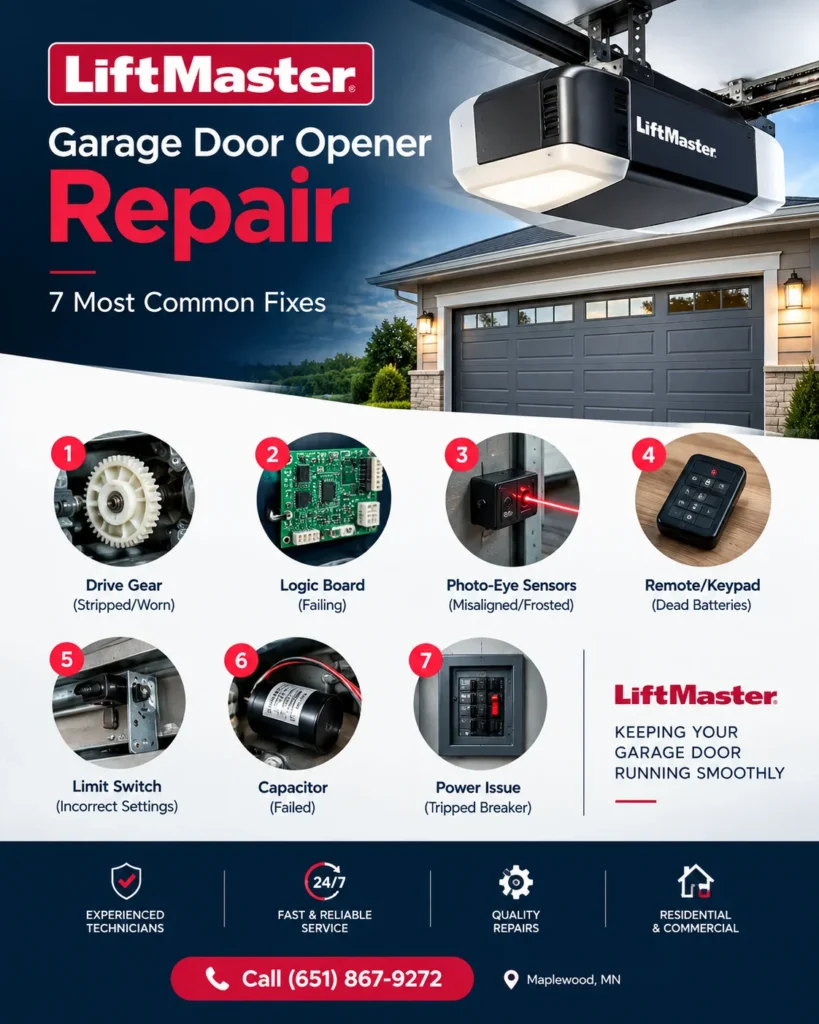
LiftMaster Garage Door Opener Repair: 7 Most Common Fixes
LiftMaster is probably the most common opener brand we see on service calls in Maplewood, and there’s a reason for that it’s been the standard builder-grade choice for decades across the Twin Cities. That popularity also means we’ve seen pretty much every way a LiftMaster unit can fail, and the honest truth is that most problems fall into one of a small handful of categories, not some mysterious one-off.
Quick Answer: The most common LiftMaster garage door opener repairs involve a stripped or worn drive gear, a failing logic (circuit) board, misaligned or frost-covered photo-eye sensors, a dead remote or keypad battery, incorrect limit switch settings causing the door to reverse or stop early, a capacitor that’s failed under heat or cold stress, and lost remote programming after a power outage. Most of these run $100–$300 to repair, and several of them like sensor alignment or a dead battery cost nothing at all if you catch them yourself before calling for service.
Why LiftMaster Specifically, and Why Minnesota Makes It Worse
LiftMaster openers are well-built, but no opener brand is immune to what a Minnesota winter does to mechanical and electrical components over time. Cold-weather cycling adds strain that a mild-climate opener never has to deal with, and Maplewood’s housing stock with a median construction year around 1980 means a lot of these units have been running for far longer than their intended service life. A garage door opener has a typical service life of about 10 to 15 years, and if the opener in your home hasn’t been replaced since the house was built, the motor, gears, and safety sensors are already operating past what they were designed for, with cold weather usually being what finally exposes the failure.
That context matters, because a lot of the fixes below aren’t really “LiftMaster problems” in the sense of a manufacturing flaw they’re what happens to any opener that’s been asked to run through 40-plus Minnesota winters, and LiftMaster just happens to be the brand installed in most of them.
1. A Stripped or Worn Drive Gear
This is one of the most frequent internal failures on LiftMaster chain and belt-drive openers. Inside the motor housing, a nylon drive gear meshes with the drive mechanism to move the door. Nylon is used deliberately it’s designed to be the sacrificial part that wears out before something more expensive fails but that also means it’s the single most common point of failure over a unit’s lifespan.
Symptom: The motor runs, you can hear it humming, but the door doesn’t move at all, or moves very slowly with a grinding sound.
The fix: Drive gear replacement is a relatively affordable, well-understood repair, and one of the more common reasons for a service call once an opener passes the decade mark.
2. A Failing Logic Board
The logic board is the opener’s “brain” it controls the motor, interprets remote signals, manages the safety sensors, and stores your programmed remotes and keypad codes. When it starts failing, the symptoms can be inconsistent and confusing, which is part of why this one often gets misdiagnosed by homeowners as something else entirely.
Symptom: The opener behaves erratically sometimes responding, sometimes not; lights flickering or not turning on when they should; the unit randomly stopping mid-cycle without an obvious mechanical cause.
The fix: In most cases, the logic board needs to be replaced rather than repaired, since it’s a sealed electronic component. This tends to run toward the higher end of the general opener repair range, but it’s still typically far less than replacing the entire opener unit.
3. Frost-Covered or Misaligned Photo-Eye Sensors
LiftMaster openers, like all modern units, use a pair of photo-eye sensors mounted a few inches off the ground on either side of the door track. If those sensors can’t see each other, the opener will often refuse to close the door at all as a safety measure.
Symptom: The door won’t close, or it starts closing and immediately reverses, even though nothing is physically blocking the doorway.
The fix: In cold, humid conditions, frost and condensation on the sensor lenses is an extremely common and completely free fix wipe both lenses clean and confirm the small LED indicator light on each sensor is solid, not blinking. If cleaning doesn’t resolve it, the sensor brackets may have been bumped out of alignment and need adjustment.
4. Dead or Weak Remote and Keypad Batteries
The least dramatic cause on this list, and often the first thing worth ruling out. Battery chemistry weakens significantly in cold temperatures, which means a remote or outdoor keypad that worked fine in October can suddenly seem unresponsive during the first hard freeze of the season, even with a battery that isn’t fully dead yet.
Symptom: The wall-mounted button operates the door normally, but the handheld remote or outdoor keypad doesn’t respond, or responds inconsistently.
The fix: Replace the battery. If the wall button also stops working, the problem is elsewhere in the system, not the battery.
5. Incorrect Limit Switch Settings
Limit switches tell the opener exactly how far to travel in each direction before stopping. When these settings drift or get bumped, the door can behave in ways that look like a much bigger mechanical problem than they actually are.
Symptom: The door stops a few inches before reaching the floor, reverses partway through closing, or doesn’t fully open before the motor stops trying.
The fix: Limit switches are adjustable, and recalibrating them is often a fairly quick fix. That said, if the settings keep drifting repeatedly on their own, that can point to a secondary issue worn gears or a failing logic board worth having a technician check rather than just readjusting the same setting over and over.
6. Lost Remote Programming After a Power Outage
This one catches people off guard because it feels like a sudden, total failure when really it’s just a memory reset. Some LiftMaster models, particularly older ones, can lose their programmed remote and keypad codes after a significant power interruption.
Symptom: After a power outage, none of your remotes or the keypad work anymore, even though the wall button still operates the door fine.
The fix: Reprogramming remotes and keypads is usually a straightforward process specific to your model, generally involving the “Learn” button on the motor unit. If you don’t have your model’s manual, the process can typically be found using the model number printed on the unit itself.
7. A Failing Capacitor
Capacitors regulate the electrical startup surge for the motor, and like anything electrical, they have a finite lifespan that gets shortened by both extreme heat and extreme cold cycling. In a climate with genuine seasonal swings like Minnesota’s, capacitors take a beating from both directions across a full year.
Symptom: The motor hums for a moment when you press the button but doesn’t fully engage, or the breaker trips right as the opener tries to start.
The fix: Capacitor replacement is a relatively contained, affordable repair, and it’s worth having tested any time you’re already having a technician out for a different opener issue, since a weak capacitor sitting right at the edge of failure often gets missed until it fully fails on its own.
A Recent Service Example: Opener Humming, Door Not Moving
This exact combination shows up constantly on cold Maplewood mornings, and it’s a good example of why guessing at the cause before an inspection isn’t a great idea. A homeowner called describing an opener that hummed but didn’t move the door at all a classic symptom that could point to several different things on this list. In this case, standard grease inside the drive mechanism had thickened in the cold to the point of adding real resistance, something the motor’s force settings weren’t able to overcome. The old lubricant was cleaned out and replaced with a low-temperature synthetic formula rated for genuine Minnesota winters, and the opener was back to functioning normally the same day.
That same symptom humming motor, stationary door could just as easily have been a stripped drive gear or a weak capacitor, which is exactly why a quick phone description alone usually isn’t enough to know for certain which of the seven fixes above actually applies.
What This Typically Costs
As a general reference, garage door opener repair in the Twin Cities area typically runs $100 to $300, covering sensor, gear, or circuit-board issues. Full opener replacement, when repair isn’t cost-effective anymore, generally runs $250 to $600 including parts and labor for a standard residential unit. Labor in the metro typically runs $75 to $120 per hour on top of parts, and a reputable technician should give you a written estimate before starting any work, regardless of which of these seven issues turns out to be the actual cause.
When Repair No Longer Makes Sense
As a rough guideline, if repair costs are creeping up toward half the price of a new opener, or if the unit is already well past its 10-to-15-year expected service life and showing multiple issues at once say, a worn drive gear and a flaky logic board replacement is usually the better long-term value rather than repeatedly repairing an aging unit piece by piece.
Real Questions, Straight Answers
Final Thoughts
Most LiftMaster opener problems come down to one of these seven causes, and a few of them a dead battery, a dirty sensor lens, lost remote programming are genuinely free to fix yourself in a few minutes once you know what to check. The ones involving the drive gear, logic board, or capacitor are better left to a technician who can confirm the actual cause rather than guessing and replacing parts that weren’t the problem.
Not sure which of these is causing your opener trouble? Call (651) 867-9272 we service all major brands, and we’ll help you figure out the actual cause before recommending any repair.