What Actually Counts as an Emergency Garage Door Repair?
Your garage door won’t budge, and you don’t know if this is a “call someone right now” problem or a “deal with it after work” problem. That single decision act now or wait is the difference between a $150 fix and a $600 one, and in some cases, the difference between a minor inconvenience and a real safety risk.
Not every stuck, noisy, or slow-moving garage door qualifies as an emergency garage door repair. But some situations genuinely do, and knowing which is which can save you money, protect your home, and keep you and your family safe. This guide breaks down exactly what counts as a true garage door emergency, what can reasonably wait for a scheduled appointment, and what to do in the minutes before help arrives.
Why This Distinction Actually Matters
Homeowners tend to fall into one of two traps. The first group panics over every squeak and calls for 24/7 emergency service when a simple daytime appointment would do, paying a premium for urgency they didn’t need. The second group ignores warning signs that genuinely require immediate attention, and ends up turning a $150–$370 spring repair into a burned-out opener motor or, worse, a safety incident.
A garage door isn’t just an appliance. It’s the largest moving object in most homes, held under enormous mechanical tension, and it’s also frequently the main point of entry to the house. That combination of heavy moving hardware plus home security is exactly why some failures can’t wait, while others genuinely can.
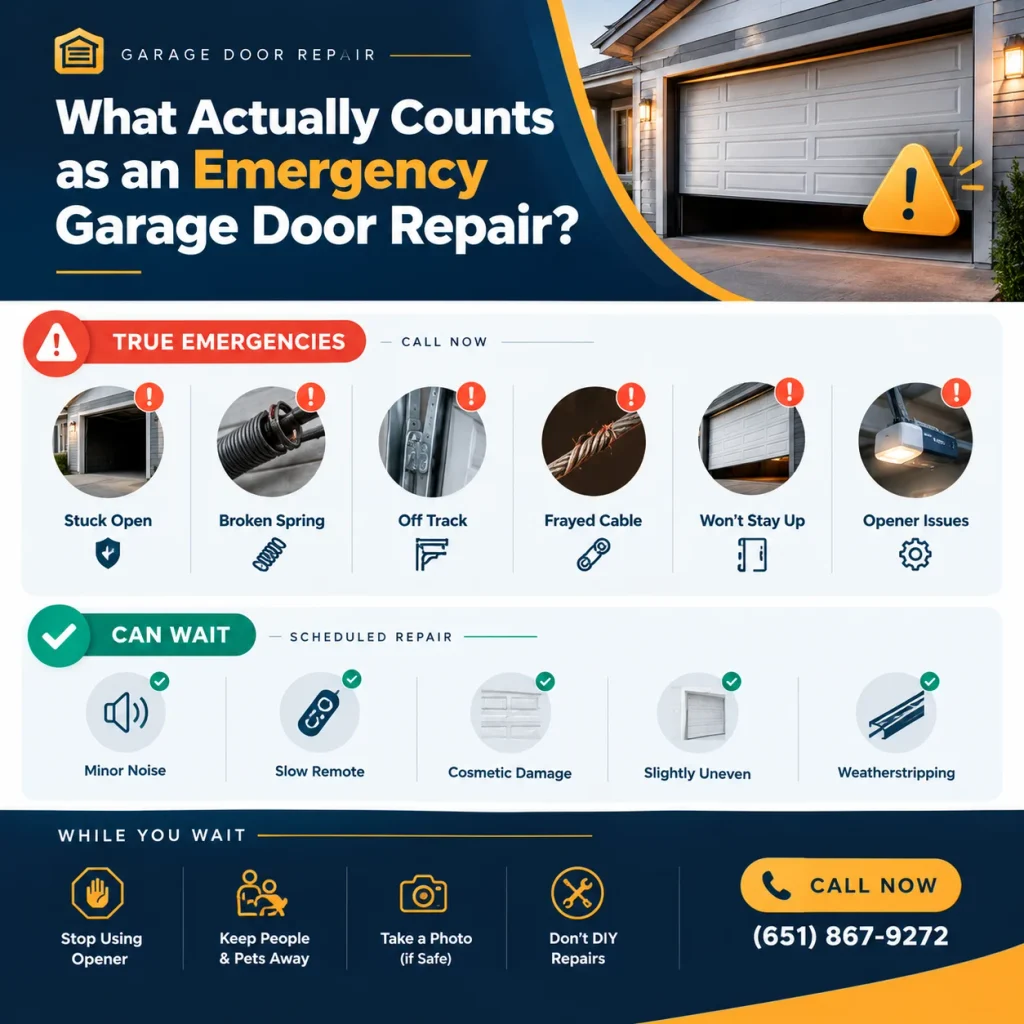
True Emergencies: When You Need Same-Day or 24/7 Garage Door Repair
These situations call for an emergency garage door repair technician immediately, not tomorrow, not “when it’s convenient.”
1. The Door Won’t Close (Security Risk)
If your garage door is stuck open especially overnight or when you’re leaving for the day this is a security emergency, not just a mechanical inconvenience. An open garage is a direct invitation into your home, and many attached garages have an interior door that isn’t nearly as secure as your front door lock. If the opener won’t respond and you can’t manually force the door down safely, this qualifies for same-day garage door repair.
2. A Loud Bang Followed by the Door Refusing to Lift
A sudden bang from the garage, followed by the door lifting only a few inches (or not at all), is the classic sign of a broken garage door spring. This is both an emergency and a safety hazard. Torsion springs are wound under enough tension to lift 300–400 pounds, and a broken spring can leave sharp, tensioned metal hardware in an unstable state. Stop using the opener immediately continuing to run the motor against a broken spring can burn it out, turning an affordable spring repair into a full opener replacement.
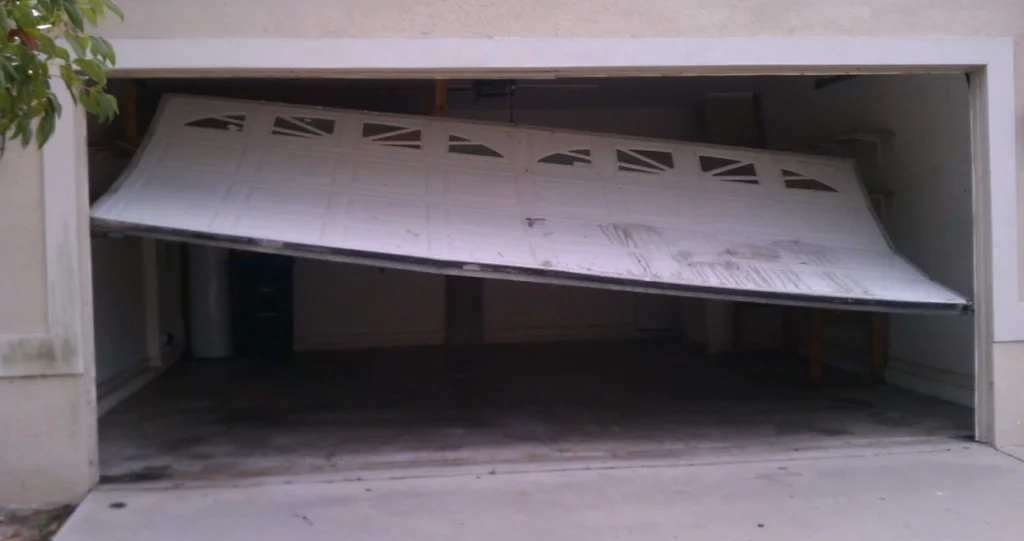
3. The Door Is Off Its Track
If the door has visibly jumped its track often after an impact, a broken cable, or worn rollers do not attempt to force it open or closed. A door that’s off-track can fall unpredictably, and the tracks themselves can bend further with each attempted cycle. This is a same-day, don’t-wait situation.
4. Cable Snapped or Visibly Frayed and About to Go
Cables work alongside the springs to control the door’s descent. A snapped cable on one side of the door can cause it to hang unevenly or drop suddenly. If you see a cable dangling, frayed down to a few strands, or wound incorrectly on the drum, treat it as an emergency garage door repair this is not a wait-and-see issue.
5. The Door Won’t Stay Up (Falling Risk)
A garage door that creeps down on its own, or drops suddenly while someone or something is underneath, is one of the most dangerous scenarios possible. This usually indicates severely unbalanced springs or a cable failure and should be treated as an urgent, same-day repair never as routine maintenance to schedule “next week.”
6. Opener Motor Straining, Smoking, or Smelling Burnt
If the opener motor is humming, straining, or you notice a burning smell, stop using it immediately. Continuing to run a struggling motor risks an electrical issue or a fully burned-out unit, both of which are more expensive and more urgent to resolve than the original mechanical problem.
Not an Emergency: Issues That Can Wait for a Scheduled Repair
These are common, frustrating, and worth fixing soon but they don’t require paying emergency rates.
- Minor noise or squeaking usually dry hinges or rollers, fixable with routine maintenance.
- Slow response from the remote often a battery issue, especially in cold weather, rather than a mechanical fault.
- Cosmetic dents or scratches on panels annoying, not urgent, unless the dent is affecting the door’s structural movement.
- Door slightly uneven or “off” by a small margin worth a scheduled inspection, not a 2 a.m. call.
- Weatherstripping wearing thin causes drafts, not danger, and can be scheduled for a regular appointment.
If your garage door is simply behaving a little differently than usual a bit louder, a bit slower but it’s still opening, closing, and reversing normally when it senses an obstruction, you almost always have time to book a standard appointment rather than pay for emergency dispatch.
What to Do While You’re Waiting for a Technician
If you’ve identified a true emergency, here’s how to keep things from getting worse before help arrives:
- Stop operating the opener. Running the motor against a mechanical failure is the single most common way a small repair becomes a big one.
- Use the manual release cord if the door is safely closed. This disconnects the opener from the door so nothing engages accidentally.
- Keep people and pets clear of the door’s path, especially if springs, cables, or tracks are visibly compromised.
- Don’t attempt spring or cable work yourself. The Consumer Product Safety Commission attributes an estimated 20,000–30,000 garage door injuries per year to this category of equipment, with roughly 65% tied to spring failure specifically. This isn’t a place to save money with a DIY fix.
- Take a photo of the issue if it’s safe to do so it helps the technician arrive prepared with the right parts, which speeds up the actual repair.
How Emergency Pricing Typically Works
Emergency and after-hours garage door repair usually costs more than a standard weekday appointment, which is consistent across the industry, not specific to any one company. A legitimate technician will quote you the exact price before dispatching a truck, not after the work is already underway. If a company won’t give you a number over the phone before showing up, that’s a warning sign worth taking seriously treat a verbal-only, no-commitment quote as a red flag, not standard practice.
Real Questions, Straight Answers
Final Thoughts
Most garage door problems are annoying but not dangerous, and they can wait for a scheduled visit. But a handful of specific situations a door stuck open, a broken spring, a snapped cable, an off-track door, or a door that won’t stay up genuinely qualify as emergencies and deserve same-day or 24/7 attention. Knowing the difference protects both your wallet and your safety.
If you’re dealing with any of the true-emergency situations above, don’t wait it out overnight. A same-day, upfront-priced repair now is almost always cheaper and safer than letting the problem run.